Friday, August 29, 2014

Biggest Natural Melon on Earth !


On Saturday, September 3rd, 2005, a small crowd gathered to watch a melon grown by Lloyd Bright being weighed at Hope Farm Store. After an almighty effort it was heaved onto the scales and nervous onlookers held their breath as the weigh-in began.

Lloyd’s vegetable behemoth was declared to be an incredible 268.8lbs – over 6lbs more than the previous record of 262lbs, held by a Tennessee man. Just a few months later, The Guinness Book of Records certified the success: this was, officially, the largest melon the Earth had ever seen – once again grown by the Bright family, a line who are amply proud of their wondrous melons!


What could be more delicious on a hot summer day than a fresh, juicy watermelon? Well, you might think twice before attempting to eat an entire giant watermelon… after all, these melons aren’t made for eating; they’re made for showing. And when it comes to that, big really is best.

Thursday, July 24, 2014

Recognizing the Signs of a Sick Goat


Your goats will let you know when something’s wrong, but you need to recognize the signs. You need to investigate further or begin taking action if you see the following signs of illness:

Not chewing cud

Not getting up

Pressing her head against wall or fence

Not eating

Feces aren’t pelleted

Not urinating or straining to urinate

Not drinking

Pale or grey eyelids or gums

Hot udder

Limping or staggering

Ears held oddly

Isolating himself from the herd

Grinding teeth

Coughing

Unusual crying

Runny nose or eyes

Friday, June 27, 2014

Providing Adequate Fencing for Your Goats

If you've decided to raise goats to green up your lifestyle, you need to provide good fencing to keep them in and to keep predators out. You can also use fencing to protect your trees and shrubs from goats. Adequate fencing means different things in different situations. If you have kids and adult goats, you need to make sure the kids can't get through the fencing and the adults can't get over it.


Goats love to rub on walls and fences. If you put in new fencing, make sure you set your fence posts deep enough. Wooden posts need to be at least two feet deep. If you're using metal T-posts, make sure to pound them in past the V at the bottom that holds them in the ground.

If you have an area with existing fencing, walk the fence line and

Inspect the fence for holes in or under it: Patch holes in the fence and fill or block holes under it.

Check each fence post to make sure it's solidly set: Replace, add a new post, or solidify the weak one.

Measure to see whether the fence is high enough: A 4-foot fence is adequate in most cases. If it isn't, add a strand or two of electric wire or fence it higher.

Determine whether any trees need to be fenced out or around: Keep goats away from trees you don't want eaten or that are poisonous.

If you need to put in new fencing or replace fencing, you have a variety of fencing types to choose from:

Field fencing: Field fencing, or woven wire, attached to metal T-posts is probably the most common type of fencing for goats. It's moderately expensive and is sturdy if installed properly. A four-foot-high field fence will keep miniature goats in but isn't high enough for a determined bigger goat. A strand of electric wire along the top and 10 inches off the ground usually keeps all goats in.

Cattle or hog panels: Galvanized cattle panel with graduated spacing makes excellent fences for goats. The panels are 50 inches high. You can add a strand or two of electric wire along the top for larger goats. To keep in miniature goat kids you may need to reinforce with chicken wire or woven wire along the bottom.

Electric wire: Electric wire is an excellent addition to any of the other types of fencing. The wire and insulators are inexpensive; the biggest cost is the charger and ground rod. A strand along the top helps keep predators out and goats and livestock guardian dogs in.

Use a 4,000-volt charger for goat fencing. If your fencing isn't near a power source, get a solar charger. Place the grounding rod in a location that is as dry as possible. Follow the manufacturer's recommendations for grounding and charger placement.

Avoid using barbed wire or wood fences for goats. Goats can get injured by the barbs.

Wednesday, June 11, 2014

How to Protect Your Goats from Poisonous Plants

Goats will eat almost anything, but you must guard against your goats eating poisonous plants. Goats ignore poisonous plants most of the time, but because of their need to browse, they may try them just for variety. Whether a goat that eats a poisonous plant shows signs of poisoning depends on how much of the plant it eats, what part of the plant it eats, the condition of the plant (fresh or dried), the time of year, and the size and health of the goat.


Some of the common poisonous plants that might grow in your pasture or backyard include:

Weeds

Bracken fern

Buttercup

Common milkweed

Foxglove

Lantana

Locoweed

Poke weed

Spurge

St. John's Wort

Water hemlock and poison hemlock

Trees

Cyanide-producing trees such as cherry, chokecherry, elderberry, and plum (especially the wilted leaves from these trees)

Ponderosa pine

Yew

Cultivated plants

Azalea

Kale

Lily of the valley

Oleander

Poppy

Potato

Rhododendron

Rhubarb

Many landscaping plants are poisonous, and a few are so deadly that even a few leaves can make your goat extremely sick. Don't believe the old wives' tale that goats always know which plants are poisonous. Before you bring your goats home, check your yard for poisonous plants. The best resource for doing so is A Guide to Plant Poisoning of Animals in North America (Teton New Media), by Anthony P. Knight and Richard Walter. You can find many chapters of it online at the http://www.ivis.org). If your goats can get their heads through a fence to the neighbor's yard, make sure that poisonous plants aren't growing within reach there.

If you find any of these plants, either remove them or make sure that your fencing will keep your goats away. If the poison plant is a tree, make sure that the leaves won't fall into the pen in the autumn by removing the tree or situating the pen far from the tree. Dried leaves can be the most deadly part of the tree.

You usually don't need to freak out if one of your goats eats a little taste of any of these plants or trees, but you do need to keep an eye on him in case he shows signs of sickness.

Talk to your neighbors about poisonous plants and ask them not to throw their garden trimmings into the yard as a treat for your goats without asking first.

Tuesday, May 20, 2014

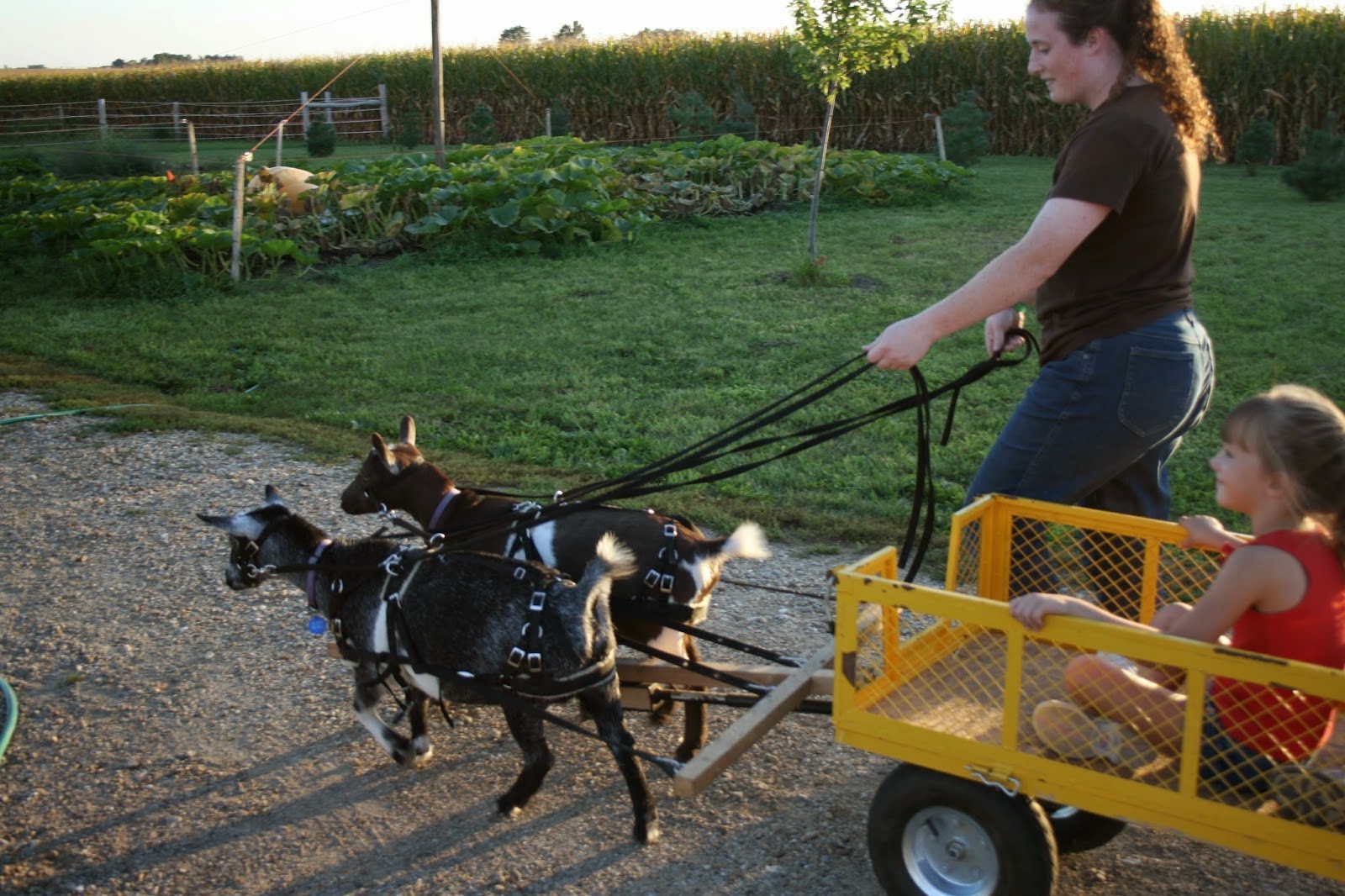
How to Train a Goat to Pull a Cart

Whether you're raising goats as part of a green lifestyle or using goats as part of a 4-H project, you can train your goats to pull a cart. First, you teach a goat to pull an empty cart. Take plenty of time with training, and train the goat away from other goats and distractions so you can both focus and avoid problems.


Before you train a goat to pull a cart, make sure that he is accustomed to being handled and is calm.

Train him on a bridle using these steps:

1.Let him sniff and mouth the bridle.

2.Put the bridle on his head, tightening all straps.

Praise the goat and give him a treat.

3.Take him for a walk while he’s wearing the bridle.

Do this every day for a week so he can get used to wearing the bridle.

4.After he’s gotten used to the bridle, attach the reins.

Take him for a walk and hold the reins so he can get used to them. Now he is ready for both.

After your goat is used to the bridle, get him used to wearing a harness. The first time you put the harness on him, put his collar and bridle on first. To train him to use a harness, take the following steps:

1.Let him sniff and mouth the harness so he gets used to it.

2.Put the harness on him.

Tighten the cinch strap, and then fasten the breast strap, and finally fasten the rump strap. Praise the goat and give him a treat.

3.Take him on a walk, using the collar to attach the lead.

Give your goat several opportunities to get used to wearing the harness.

4.After he has gotten used to the harness, attach the lead to the harness instead of the collar.

Intermittently, gently pull on the harness to simulate the feeling of a cart being pulled. Praise the goat and give a treat.

5.Take your goat on a walk while he is wearing the harness and bridle with reins, and teach him to stop, go, and turn to the left and right.

When you want him to stop, say “Whoa” or “Stop.” Pull the reins if your goat doesn’t stop. Say “Go” or “Walk” when you want him to go and “Left” to go left and “Right” to go right. Practice these commands every day for a week or so, rewarding your goat when he complies, until he gets it.

6.Practice with a travois.

Before you get a real cart, you need to simulate a cart in a safer way. Attach a travois to the harness and take your goat through the commands. To make a travois, get two long poles and a shorter pole and lash them together into a triangular shape. Practice with a travois for a week or so before attaching your goat to a cart or wagon.

7.Attach your goat to a cart.

Let your goat look at and smell the cart. When he loses interest in it, hook him up and go.


Thursday, April 24, 2014

Norwegian dairy goat


The breed originates from the north-European landrace. The introduction of other breeds has been minimal the last decades except from some import of saanen goat. Previous the Norwegian goat was divided into a lot of geographical breeds/ types i.e. telemark goat, doele goat, western goat and nordland goat. Today, it’s a genetic connection between all the areas in Norway as a consequence of modern breeding work and extensive use of AI. Because of this, the dairy goat in Norway was denoted as one common breed at the early 1990’s. 

The variation is huge. Both horned and natural polled exists. Short and long shag exists and it’s a huge variation in amount of cashmere wool.It is found in gray, blue, white or pied coloration. A huge variation in markings and colour combinations. Average adult weight: 50 kilo. 

Milk production: 577 kg/ year (2,94 % protein, 3,50 % fat and 4,23 % lactose).


Tuesday, April 1, 2014

How to Raise a Pig on a Farm

Raising pigs from cute piglets to large hogs can be a rewarding experience. Pigs are some of the most intelligent animals on the farm, but also some of the most odiferous. They can be welcome playmates to children, sold or served for Sunday dinner. With care and daily attention you can raise pigs as pets or for profit.


1.Provide adequate housing for your pig. The structure can be a prefabricated pig house or an A-frame structure within a fenced paddock. According to the University of Wisconsin, a nursery pig requires at least 3 to 4 square feet of space on a solid floor or 2 to 4 square feet for a slotted floor in the housing. Pigs up to 150 pounds require 6 square feet of housing and another 6-square-foot paddock. Pigs that weigh 150 to 265 pounds will need 8 to 10 square feet of both housing and paddock. Author and livestock expert Laura Childs suggests using concrete flooring with a drain in one corner of the pig housing to ease cleaning.

2.Place sandy pasture soil in the paddock. Include deep straw bedding in the housing for the pigs to burrow in during cooler months. Place a self-feeder and waterer in the housing or paddock. The Maine Organic Farmers and Gardeners Association recommends providing toys to satisfy your pig's curious nature.

3.Maintain a comfortable temperature for your pig. According to the University of Wisconsin, the optimal temperature range is 80 to 85 degrees for piglets, 70 to 75 degrees for weaned pigs and 60 to 70 degrees for finisher pigs. You will need heat lamps or heat pads for the winter months.

4.Feed your pig a grain mix that is high in nutrients with 16 percent protein. The average young pig will eat about 2.75 lbs. of feed a day. Feed once a day or break the grain into 2 portions. Pigs will free-eat throughout the day.

5.Clean the pig barn area daily. If you have a drain you can spray the concrete flooring with a water hose and drain away the waste. Or you can shovel the solids and mop the flooring.

6.Take your pig to a livestock veterinarian. The vet will inform you about which vaccines are necessary in your area and will provide the pig with a necessary wormer. Pigs require a wormer at 40 to 50 pounds and again at 100 pounds.